Showing posts with label salvia. Show all posts

25 June, 2023

Six on Saturday - 24th June 2023

All things blue and beautiful

A whole five months since my last post and I've not even managed to get it out on a Saturday! I did actually start writing it early yesterday morning and I started with  "It's a beautiful morning". Then, all the jobs that I set myself to get done before heading out for a day of singing took over, and that's as far as I got. So, now it is Sunday afternoon. Let's see how far we get this time. 

It's a swealtering 29 degrees outside, Sunday afternoon 24th June  2023. At times like this I'm really grateful for the shaded areas of the garden and earlier I took full advantage, sitting right down at the bottom writing up my diary, and completing this week's column in my gardening five year record book, something I also started earlier in the year. In fact the record book is possibly the reason for not getting back to the blog as by the time I've written that up I've thought of a thousand things to do in the garden and then, before I know it, it is not Saturday anymore. 

It's the time of year when all the learner fledglings try out the bird feeders. A new one this year has been a young greater spotted woodpecker. For a couple of weeks now it has followed its mother around the garden,  calling after her and landing slightly ginergly, sometimes ending up suspended underneath a feeder and apparently trying to work out "what next". Today it was alone and a lot more confident.  Also out and about are a large number of damselflies. Earlier in the week there were at least four pairs, hooked up in tandem, the rear female dipping her tail in the pond, presumably laying eggs. And after some refreshing rain, rain which filled two of the four water butts, I saw at least two toads. I'd been worried they'd all disappeared, especially as it looks as though this season's eggs did not survive a March frost. 

Anyhow, to planty things going on in the garden here in south east London: 
 

One: bright blue Hydrangea Macrophylla Zorro

Hydrangea Macrophylla "Zorro"


Last year Zorro's flowering season was brought to a juddering halt with the insane 40 degree heat that we had. I pruned it earlier in the year and it is coming back very nicely indeed, and still nice and blue. It is in its own pot, planted in ericaceous soil, and watered with rainwater with added fortification. I don't think the flowers are quite as large as previously but there are a healthly number of them, all on gorgeous dark, nearly black, stems. 

Two: beginning to go blue

Hydrangea

I've been giving Mum's hydrangea the "Zorro" treatment. I've had it since she passed in 2014 and it has been pink most years. It certainly has some blue tinges now. Come back in another year or two to see if I've been successful in turning the pompoms blue. 

Three: blue bee heaven
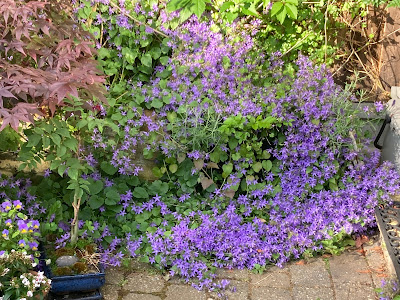
Campanula

This is one of several profusions of campanula which are dotted around the garden. The bees adore it if the buzzing is anything to go by.  

Four: bicycle blues


An ornamental wrought iron bicycle planter with pots of flowers in the front basket, side pedals, the seat and in the rear paniers. Filled with lobellia and pelargonium


Dad gave me this last year and would have loved to see it planted up like this. He and Annie had had it in their garden in Lincolnshire and it had become completely overgrown with brambles. We extracted it and realised that it could still be used as a rather quirky planter. Here it is tumbling with lobelia and geraniums. 

Five: Salvia "amethyst lips
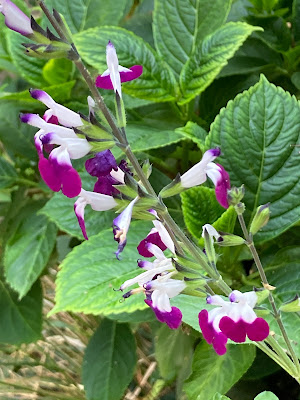
Salvia "amethyst lips"

I've discovered Salvias through our local gardening club. Seven are in flower at the moment with only Amistad and Black and Blue waiting to take off.  

Six: fortification

A fruit cage containing four pots of fruit, 2x strawberries, one lemon tree and a blueberry bush


The air was blue the other weekend when I realised that the squirrels had taken all my figs and most of the nearly ripe strawberries. I have now acquired this cage into which I've put the strawberries, the lemon tree - the blighters took all those last summer - and a blueberry bush. A determined squirrel will probably get through but I'm hoping this will be a sufficient deterrant for now and that I've secured it sufficiently so that the birds and the toads don't get tangled up in it. 

This is my latest in the #SixOnSaturdon ay series inspired by The Propagator and currently being championed over at Garden Ruminations. Check out the participant guide here. I aspire to be as disciplined, creative and inspiring as them but for now, I'll remain pleased if I can just limp on with a post every now and again.   

24 September, 2022

Six on Saturday - 24th September 2022

 Six Salvia Survivors

Two months since my last post in the #SixOnSaturday in the series inspired by The Propagator. That insanely hot weather was only the beginning and the severe lack of rainfall here has been a bit of a wake-up call for me and I've lost a few large shrubs as a result. It will probably be spring before I know the full extent of the casualties but for now, six surviging salvias, three of which are brand new to me this year. They have all survived and are in glorious bloom at the moment. Not that you'd know from these images as for some reason I find them incredibly difficult to photograph! If only the internet were "scratch and sniff" as every single one has wonderfully fragrant leaves. My first was acquired from a member of our gardening club, and my further interest was piqued by another member.  I may now be hooked!

Close up picture of a salvia flower and leaves

1) Salvia I know not what (yet) - something peachy

I'm going from newest to oldest. This was an impulse buy and it didn't have a label. In the "Before Times" a Christmas present from my niece was a voucher for a trip to The Savill Garden. We finally managed to redeem it a few weeks ago and it was a glorious visit. On the way out, there were some plants for sale, including this salvia. It was a bit leggy and in the reduced section but the one and only flower on this plant was a lovely peachy colour, one I'd not seen before on a salvia. So I acquired it. I've planted it in a sunny bed next to a Santolina and the peach flowers work really well with the silvery leaves in the background. I have no idea whether it is "peaches and cream" or something else, but I like it and will attempt to propogate it. at the moment it is about 30cm high but it has only been in about 8 weeks so we'll just have to see if it needs relocating at some point.   

Flower spire and leaves of Salvia black and blue

2) Salvia "black and blue".

Yes, you saw this last time and it has been flowering furiously since. I'd guess it is about 90cm tall now. Some of the leaves have been nibbled but nothing drastic. It still looks wonderful against the yellow rudbekia and that colour combination is giving me ideas for next year as I fill some of the gaps where plants didn't survive.

Flowers and leaves of Salvia "Amethyst lips"

3) Salvia "Amethyst Lips"

This salvia is in a more shady part of the garden. It is another in the "lips" series and also has a tendancy to flop so I've got it supported.   

Flower spire and leaves of a tall Salvia Amistad

4) Salvia "Amistad"

The third first for me and now the largest salvia in the garden. It must be about 1.5m tall and has put on all that growth since planting earlier in the summer. It, too, has been throwing off flower spikes for weeks and weeks now. Another one that is giving me ideas for next year. Currently it sits behind "black and blue" but I think I'll separate them, and then pair both with something yellow and/or something silvery.  

Salvia flower pairs

5) Salvia greggii "Neon Rose"

The vibrant colour of this one is almost impossible to capture. It has survived on complete and utter neglect and is rewarding me with a lovely shower of flowers which really pop out of the bed as you walk along the garden. I'm going to try to propogate this one too before cutting back the parent plant a bit in an attempt to turn it from being a bit leggy into something more bushy.       

Close up of salvia "hot lips" flowers beside a view of the larger plant with many flowers

6) Salvia "hot lips"

This was my first salvia. I acquired it as a cutting taken from a plant belonging to one of the members of our local gardening club and I managed to root it. For someone who up to that point had not always had much success in rooting things, this plant is indeed special. It is an unruly bush is beside a path and is now held from flopping completely across it by a semicircular support. It has survived both the "Beast from the East" and this summer's intense heat and drought. Brushing past it as I head down the garden releases the gorgeous aroma of the leaves. Its offsprings are happily rooting away in the greenhouse. 

That's all for this week. Check out the participant guide if you want to join in. 

23 July, 2022

Six on Saturday - 23rd July 2022

Some like it hot

Phew, what a scorcher that was! I imagine I'm not alone as I wander around my garden to see what has survived and what has been fried to a crisp after those record temperatures earlier in the week. It was as though someone had taken a huge hairdryer to some of the plants. But not all is lost and, indeed, some seem to like the heat so here are my #SixOnSaturday in the series inspired by The Propagator.   

Single canna bloom

1) Canna "Wyoming"

Well look who likes the heat! This is this plant's fourth year and third location. Only last year did it flower for the first time and it is promising a good show again this year. It sits well with the blue geranium, hemerocallis and salvias in the same bed but I'm thinking I'll place it further back in the bed next year. .  

Single rudbeckia bloom

2) Rudbeckia

These were grown from a packet of seeds acquired from one of our garden club members. They've been very floppy and I feared that the slugs and snails would devour them as soon as I planted them out. But no, they've survived and like the Canna, seem to like the heat and have now started flowering. I love that the yellow petals look like they have been dipped in chocolate, or is it that the chocolate petals have been dipped in yellow?

Two yellow zantendeschia blooms

3) Zantendeschia

Another heat lover, apparently. These are in their first year and have produced lovely soft yellow blooms. They are not hardy so will have to be brought in at the first sign of frost. Just right now that is pretty hard to imagine!  

Single sunflower bloom

4) Another sunflower

Yes, for the third week in a row I give you a sunflower, another from he seeds acquired from one of our gardening club members. This one has a double row of more rounded petals and the flower head is more palm sized than dinner plate.  

5) Salvia guaranitica "black and blue"

Another first for me and one acquired in a moment of spontaneity. We have a lovely local independent garden centre just opposite the station entrance. Occasionally I'll pop in on my way home from work, if nothing else for the gorgeous scents and the calming background jazz that is often playing. It is a teeny bit of paradise in south east London. On this occasion I had a mission - to acquire a late flowering clematis. They had none. Instead, this salvia grabbed my attention with its distinctive deep blue flowers and black stems. The leaves are larger than the other salvias in my garden. It has survived the heat and is throwing off a succession of blooms. It is in the same bed as the hemerocallis and I like the contrast of the orange and the blue.      

two white flowers on a green stalk

6) Spider plant flowers

Having had spider plants for most of my adult life, I honestly don't ever remember one flowering. This is one of several plantlets that I harvested from a  mature one growing in my office and I've started them off outside. I popped this one into a larger pot a couple of weeks ago and it promptly threw off its own new clutch of youngsters along with these two pretty white flowers. I quick look on t'internet confirms that they don't actually flower at all regularly and that when they do, the flowers are short lived so I'm right not to remember them and glad that I captured these ones in their prime.

That's all for this week. This weekend I'll be deadheading and possibly planting out some of the more vigorous inhabitants of the greenhouse. Check out the participant guide if you want to join in. 

23 October, 2021

Six on Saturday - 23rd October 2021

Leaves, seeds and propagation

It's the time of year when I not only mow the lawn, but also the paths, effectively using the mower as a means of chopping up and hoovering up all the fallen leaves prior to adding them to the compost bin.

This week's #SixOnSaturday, inspired by The Propagator has a leafy theme.  

Image of a spikey seedhead

1) Teasel seedhead

I'm liking the rather striking seedheads and am looking forward to seeing them over winter, especially if we get a frost.  

Image of a large leafed plant about to come into bloom

2) Varietad Fatsia Japonica

With leaves bigger than most dinnerplates, this variegated fatsia provides year round interest. Here, it is poised to flower, providing some much needed food over winter for polinators.  
  
Image of six square plant pots each with cuttings in it

3) Propagation time

I've had mixed success with cuttings, but enough success that I still give it a go. I particularly concentrate on things that work in the garden, which aren't fodder for slugs and snails, and which are useful for filling gaps here and there, or for replacing plants that have gone leggy. This little group includes some Artemesia "Powis Castle", Erysimum (don't know variety name but it produces flowers that have orange through to purple tinges) and some Salvia. The Artemisia and Salvia both have deliciously fragrant leaves. 

Image of a single straight leaf

4) Variegated Phormium

We got our first phormium in 1993. It grew and grew and grew, it "walked" from the back of the border to the front and in the end, we had it taken out. I reckon I got about fifty viable plants from the original and since then I have used them as architectual backdrops at the backs of borders or in pots. The best specimens are perfectly fan shaped. I now keep an eye out for further offspring and remove those and pot them up for passing on. The leaves on this one are fantastically stripey and look great in a gentle breeze as they dance about. 

Image of some leaves and a flowerhead

5) Mahonia

This is another plant that provides year round leafy interest This variety is called "soft caress" and doesn't have the spiky leaves of the more common variety. As with the Fatsia, this is poised to flower. When it does it produces gorgeously scented flowers which are loved by the polinators, and then lovely black berries which are devoured by the birds.  


Image of a segmented leaf

6) Virginia creeper

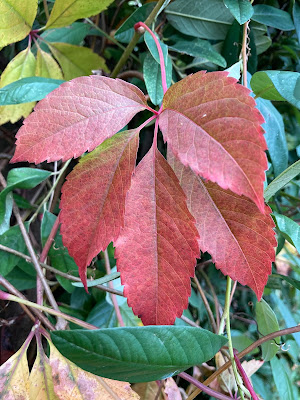
The virginia creeper is providing loads of colour this year and the birds are still feasting on the berries.

This weekend's jobs include dividing and potting up some houseplants, and perhaps some more cuttings. It also includes pulling out some brambles which I spotted as I was taking pics for this week's Six! Meanwhile, the cosmos flowerbuds are getting bigger and bigger and I'm hoping will burst onto the scene soon. 

That's all for this week. Check out the participant guide if you want to join in. 

Telegraph Hill Open Gardens 2026

  Telegraph Hill Open Gardens 2026 Saturday 6th and Sunday 7th June 2026, 14:00 - 18:00 We have 18 gardens lined up to open across the weeke...