Showing posts with label Gardening. Show all posts

06 March, 2026

Telegraph Hill Open Gardens 2026


Telegraph Hill Gardens logo

Telegraph Hill Open Gardens 2026

Saturday 6th and Sunday 7th June 2026, 14:00 - 18:00

We have 18 gardens lined up to open across the weekend of 6th/7th June. Here's a map of gardens opening over the weekend. Keep this page bookmarked for latest updates for the weekend itself when we look forward to welcoming you to our private gardens in Telegraph Hill, SE London.


Entry is free but we welcome donations, including those raised through the sale of refreshments and/or plants. 

This year we will be supporting the children's kitchen garden project at Edmund Waller Primary School - you'll be able to see their work in progress over the weekend as they are one of our 18 gardens!

About our gardens

The Telegraph Hill Garden Club is made up of local amateur gardeners keen to share experiences of gardening on the hill with our mix of slopes, clay, aspect, trees, more trees and our love of this green corner of South East London. Over the years some of us have opened our gardens to the public as part of the Telegraph Hill Festival and, with funds raised through donations (including gardeners offering plants and refreshments), we have supported local green projects including roundabout planting, street trees, and, most recently, the next generation of gardeners at Edmund Waller Primary School. Our gardens are not perfect, they are honest local gardens with gardeners willing to share what we have learned about or local conditions and habitat. 


25 June, 2023

Six on Saturday - 24th June 2023

All things blue and beautiful

A whole five months since my last post and I've not even managed to get it out on a Saturday! I did actually start writing it early yesterday morning and I started with  "It's a beautiful morning". Then, all the jobs that I set myself to get done before heading out for a day of singing took over, and that's as far as I got. So, now it is Sunday afternoon. Let's see how far we get this time. 

It's a swealtering 29 degrees outside, Sunday afternoon 24th June  2023. At times like this I'm really grateful for the shaded areas of the garden and earlier I took full advantage, sitting right down at the bottom writing up my diary, and completing this week's column in my gardening five year record book, something I also started earlier in the year. In fact the record book is possibly the reason for not getting back to the blog as by the time I've written that up I've thought of a thousand things to do in the garden and then, before I know it, it is not Saturday anymore. 

It's the time of year when all the learner fledglings try out the bird feeders. A new one this year has been a young greater spotted woodpecker. For a couple of weeks now it has followed its mother around the garden,  calling after her and landing slightly ginergly, sometimes ending up suspended underneath a feeder and apparently trying to work out "what next". Today it was alone and a lot more confident.  Also out and about are a large number of damselflies. Earlier in the week there were at least four pairs, hooked up in tandem, the rear female dipping her tail in the pond, presumably laying eggs. And after some refreshing rain, rain which filled two of the four water butts, I saw at least two toads. I'd been worried they'd all disappeared, especially as it looks as though this season's eggs did not survive a March frost. 

Anyhow, to planty things going on in the garden here in south east London: 
 

One: bright blue Hydrangea Macrophylla Zorro

Hydrangea Macrophylla "Zorro"


Last year Zorro's flowering season was brought to a juddering halt with the insane 40 degree heat that we had. I pruned it earlier in the year and it is coming back very nicely indeed, and still nice and blue. It is in its own pot, planted in ericaceous soil, and watered with rainwater with added fortification. I don't think the flowers are quite as large as previously but there are a healthly number of them, all on gorgeous dark, nearly black, stems. 

Two: beginning to go blue

Hydrangea

I've been giving Mum's hydrangea the "Zorro" treatment. I've had it since she passed in 2014 and it has been pink most years. It certainly has some blue tinges now. Come back in another year or two to see if I've been successful in turning the pompoms blue. 

Three: blue bee heaven

Campanula

This is one of several profusions of campanula which are dotted around the garden. The bees adore it if the buzzing is anything to go by.  

Four: bicycle blues


An ornamental wrought iron bicycle planter with pots of flowers in the front basket, side pedals, the seat and in the rear paniers. Filled with lobellia and pelargonium


Dad gave me this last year and would have loved to see it planted up like this. He and Annie had had it in their garden in Lincolnshire and it had become completely overgrown with brambles. We extracted it and realised that it could still be used as a rather quirky planter. Here it is tumbling with lobelia and geraniums. 

Five: Salvia "amethyst lips

Salvia "amethyst lips"

I've discovered Salvias through our local gardening club. Seven are in flower at the moment with only Amistad and Black and Blue waiting to take off.  

Six: fortification

A fruit cage containing four pots of fruit, 2x strawberries, one lemon tree and a blueberry bush


The air was blue the other weekend when I realised that the squirrels had taken all my figs and most of the nearly ripe strawberries. I have now acquired this cage into which I've put the strawberries, the lemon tree - the blighters took all those last summer - and a blueberry bush. A determined squirrel will probably get through but I'm hoping this will be a sufficient deterrant for now and that I've secured it sufficiently so that the birds and the toads don't get tangled up in it. 

This is my latest in the #SixOnSaturdon ay series inspired by The Propagator and currently being championed over at Garden Ruminations. Check out the participant guide here. I aspire to be as disciplined, creative and inspiring as them but for now, I'll remain pleased if I can just limp on with a post every now and again.   

24 September, 2022

Six on Saturday - 24th September 2022

 Six Salvia Survivors

Two months since my last post in the #SixOnSaturday in the series inspired by The Propagator. That insanely hot weather was only the beginning and the severe lack of rainfall here has been a bit of a wake-up call for me and I've lost a few large shrubs as a result. It will probably be spring before I know the full extent of the casualties but for now, six surviging salvias, three of which are brand new to me this year. They have all survived and are in glorious bloom at the moment. Not that you'd know from these images as for some reason I find them incredibly difficult to photograph! If only the internet were "scratch and sniff" as every single one has wonderfully fragrant leaves. My first was acquired from a member of our gardening club, and my further interest was piqued by another member.  I may now be hooked!

Close up picture of a salvia flower and leaves

1) Salvia I know not what (yet) - something peachy

I'm going from newest to oldest. This was an impulse buy and it didn't have a label. In the "Before Times" a Christmas present from my niece was a voucher for a trip to The Savill Garden. We finally managed to redeem it a few weeks ago and it was a glorious visit. On the way out, there were some plants for sale, including this salvia. It was a bit leggy and in the reduced section but the one and only flower on this plant was a lovely peachy colour, one I'd not seen before on a salvia. So I acquired it. I've planted it in a sunny bed next to a Santolina and the peach flowers work really well with the silvery leaves in the background. I have no idea whether it is "peaches and cream" or something else, but I like it and will attempt to propogate it. at the moment it is about 30cm high but it has only been in about 8 weeks so we'll just have to see if it needs relocating at some point.   

Flower spire and leaves of Salvia black and blue

2) Salvia "black and blue".

Yes, you saw this last time and it has been flowering furiously since. I'd guess it is about 90cm tall now. Some of the leaves have been nibbled but nothing drastic. It still looks wonderful against the yellow rudbekia and that colour combination is giving me ideas for next year as I fill some of the gaps where plants didn't survive.

Flowers and leaves of Salvia "Amethyst lips"

3) Salvia "Amethyst Lips"

This salvia is in a more shady part of the garden. It is another in the "lips" series and also has a tendancy to flop so I've got it supported.   

Flower spire and leaves of a tall Salvia Amistad

4) Salvia "Amistad"

The third first for me and now the largest salvia in the garden. It must be about 1.5m tall and has put on all that growth since planting earlier in the summer. It, too, has been throwing off flower spikes for weeks and weeks now. Another one that is giving me ideas for next year. Currently it sits behind "black and blue" but I think I'll separate them, and then pair both with something yellow and/or something silvery.  

Salvia flower pairs

5) Salvia greggii "Neon Rose"

The vibrant colour of this one is almost impossible to capture. It has survived on complete and utter neglect and is rewarding me with a lovely shower of flowers which really pop out of the bed as you walk along the garden. I'm going to try to propogate this one too before cutting back the parent plant a bit in an attempt to turn it from being a bit leggy into something more bushy.       

Close up of salvia "hot lips" flowers beside a view of the larger plant with many flowers

6) Salvia "hot lips"

This was my first salvia. I acquired it as a cutting taken from a plant belonging to one of the members of our local gardening club and I managed to root it. For someone who up to that point had not always had much success in rooting things, this plant is indeed special. It is an unruly bush is beside a path and is now held from flopping completely across it by a semicircular support. It has survived both the "Beast from the East" and this summer's intense heat and drought. Brushing past it as I head down the garden releases the gorgeous aroma of the leaves. Its offsprings are happily rooting away in the greenhouse. 

That's all for this week. Check out the participant guide if you want to join in. 

16 July, 2022

Six on Saturday - 16th July 2022

Back after a break

As we brace ourselves and our gardens for some blistering UK heat in the coming days, here are my #SixOnSaturday in the series inspired by The Propagator. This week's six includes a houseplant. There are some things which you'll have seen before as this blog is now more than a year old. I'll start, though, with a new one for me.  

Single bloom of Passiflora caerulea

1) Passiflora caerulea: blue passionflower

My second attempt at growing a passionflower. The first was munched beyond survival. This one was more mature when planted and has fared better. Initially I thouhht it wouldn't survive but after about six weeks it has climbed up the arch, in and around some sweet peas and is now flowering.  It is lovely and exotic.  

Zantendeschia flower

2) Zantendeschia

I managed successfully to overwinter my Zantendeschia and it has just begun to bloom again. At the moment, it is a pot of white flecked leaves with this single bloom reaching for the sky. I'm hoping that the other plants in the pot will bloom again as I recall that some were deep purple and should contrast nicely with this one.  
 
Sunflower head

3) Sunflower

Yes, another sunflower. Last week's had a darker inner ring to the petals. This one is uniformly yellow. It is another one grown from seeds acquired through our local gardening club.  

Single orange bloom of hemerocallis fulva

4) hemerocallis fulva: daylily

Another gardening club acquisition which has come back very strongly this year. This one is in a very sunny position and seems to like it a lot. Each flower lasts a day, followed a day later by a new bloom. This plant has been going for at least three weeks now and is still producing new flowers-in-waiting. Interestingly, the leaves don't seem to have been chewed as much as they were last year.    

Orchid bloom

5) A revived gift

I was given this orchid for my birthday last September. It was laden with blooms most of which promptly dropped before opening. I was resigned to staring at its glossy leaves for the remainder of its life. Imagine, then, my excitement when it threw off new stems. It is now flowering strongly and bringing joy to the bathroom.    

Closed and open bloom of the balloon flower Platycodon

6) Platycodon grandiflorus: balloon flower

Mum's platycodon is flowering vigorously again this year. This is one of three potted plants of hers that I acquired after her death in 2014 so, as you might imagine, it holds a special place in my heart and in the garden. You can see where it gets its common name from as the bloom starts as a closed balloon before opening up to reveal the delicately veined almost blue flowers which are much loved by the polinators. 

That's all for this week. This weekend is about staying cool and hydrated. Check out the participant guide if you want to join in.

02 July, 2022

Six on Saturday - 2nd July 2022

Back after a break

Yes, my first #SixOnSaturday since way back in November 2021. Many flowers have been and gone since then, a new larger greenhouse has been constructed, and a bed that I'd not tackled for the 38 years I've been at this address has been dug and replanted. It did, as I predicted, give up some of the huge chunks of glazed bricks and concrete which some previous owner burried throughout our garden, wheelbarrows of them. I need to tackle more before I get too much older and creakier as each is a huge and exhausting project. This week's #SixOnSaturday, in the series inspired by The Propagator, starts with a major success.  

Blue flower of hydrangea zorro

1) Hydrangea macrophylla "Zorro"

Zorro featured on 10th July last year and was stubbornly pink alongside Mum's pompom hydrangea. I have been on a mission to see if I could get both to revert back to blue as I'd seen both blue when I first "met" them. Even though both were in pots of erricaceous compost, and only being watered with rainwater, both were pink. I resorted to a product which claimed to help restore the blue colour. It has worked beautifully with Zorro but mum's plant remains pink, possibly very slightly less pink than the last few years. My present theory is that Zorro was blue more recently than mum's, and that therefore there may yet be hope for mum's if I continue the treatment. I'll be back next year with the news. Meanwhile, Zorro is putting on an absolutely fabulous show with its blue flowers and striking black stems. My only challenge with it being in a pot is that it is now taller than me and I'd need stilts to appreciate its full spleandour. Hey ho.  

Plant with purple leaves and white flowers

2) Oxalis

I acquired my first oxalis a number of years ago. It was outdoors in the garden centre so I put it outdoors in my garden. It did that perennial thing - flowered, died at the end of the next year, returned the following year and, most importantly, didn't get eaten by slugs and snails. So I bought some more. This one sits on our exceptionally sunny kitchen window sill - completely the wrong place according to the experts - and is a gorgeous mound of dark purple shamrock leaves and pretty pink flowers. I gather it is usually grown as a housplant in the UK, so I guess that's global warming for you. 
 
Large yellow sunflower flowerhead

3) Sunflower

Here I am in my sixth decade and this is the first sunflower that I've grown from seed and which has not been eaten, decapitated or otherwise destroyed by unknown forces. I'm sure this one, too, is at risk, but it has been in the garden bringing jolly joy for a fortnight now. It is a record. The seeds for it and, yes, others, came from a gardner's club seed swap. Knowing that the parent was grown locally gave me hope which has been rewarded. 

flowers

4) Unlikely survivors

Purchased as bedding plants in 2021 and inserted into just about the most high maintenance - small hexagonal frame, needs watering regularly - space, these have nevertheless overwintered only to come back for a second year. Words fail . . .   

5) Lemon in waiting

I acquired my first lemon tree in 2020. I overwintered it indoors - bad mistake as the dry heat resulted in significant leaf loss. It survived, went outside last year and produced a few lemons. Last winter I over-wintered it in a greenhouse by the house. Leaves remained attached, as did the unripe lemons. Then, after I thought that it was safe to put it out, I put it out - bad mistake n.2 as the shock of the outside resulted in near total leaf loss. I did not give up. Right now it is covered in lovely new dark leaves and very many headily-scented flowers. I am hopefull that fruit will follow.   

View through the entrance to a greenhouse showing young plants on shelves

6) Propogation central

The challenge with the bottom half of the garden is that it is surrounded by very mature trees. Anything I plant directly into the ground immediately competes with tree roots for water and nutrients. Add raised beds and compost and what you get is a raised bed full of tree roots! I've gone from feeding expensive plants to slugs and snails to feeding local trees. Meanwhile, my tiny greenhouse by the house was overflowing with cuttings and has been a very successful location for maturing tomatoes. I decide to clear one of the raised beds down the bottom, get it level, and install a second larger model. I'd originally thought I'd treat myself to a very fancy new greenhosue but after a frustrating exchange with a potential supplier, went very low budget with a larger version of the zip-up one by the house. A "feature" of our garden is that nothing is level, Telegraph Hill is, well, a hill, and we are on the side of it. Job one - see if you can create a level surface in a sloping garden. Even though what I'd purchased was a very cheap model, I decided I'd try to protect its frame. We try to re-cycle things and to do that, we store things that "might be useseful". In amongst the stash we had the wood that had been used as shuttering when we had our front path laid, and some offcuts of stone from when we had the steps replaced. We also had some old radiator bricks, and the slats from some old wooden venetian blinds. I created a frame for the greenhouse base (to stop it rusting) which itself is laid on the radiator bricks and infilled with gravel (to keep the wood from rotting any time soon) and the greenhouse frame is attached to the wooden frame using pipe clips. Two of the stone offcuts form the centre floor and gravel fills all the gaps. And those venetian blind slats I hear you ask? I've used those to form shelves for the lowest level of the greenhouse. Oh, and the whole thing is now rammed full of cuttings and some of this year's tomatoes.

That's all for this week. This weekend is deadheading and shrub pruning. Check out the participant guide if you want to join in.

23 October, 2021

Six on Saturday - 23rd October 2021

Leaves, seeds and propagation

It's the time of year when I not only mow the lawn, but also the paths, effectively using the mower as a means of chopping up and hoovering up all the fallen leaves prior to adding them to the compost bin.

This week's #SixOnSaturday, inspired by The Propagator has a leafy theme.  

Image of a spikey seedhead

1) Teasel seedhead

I'm liking the rather striking seedheads and am looking forward to seeing them over winter, especially if we get a frost.  

Image of a large leafed plant about to come into bloom

2) Varietad Fatsia Japonica

With leaves bigger than most dinnerplates, this variegated fatsia provides year round interest. Here, it is poised to flower, providing some much needed food over winter for polinators.  
  
Image of six square plant pots each with cuttings in it

3) Propagation time

I've had mixed success with cuttings, but enough success that I still give it a go. I particularly concentrate on things that work in the garden, which aren't fodder for slugs and snails, and which are useful for filling gaps here and there, or for replacing plants that have gone leggy. This little group includes some Artemesia "Powis Castle", Erysimum (don't know variety name but it produces flowers that have orange through to purple tinges) and some Salvia. The Artemisia and Salvia both have deliciously fragrant leaves. 

Image of a single straight leaf

4) Variegated Phormium

We got our first phormium in 1993. It grew and grew and grew, it "walked" from the back of the border to the front and in the end, we had it taken out. I reckon I got about fifty viable plants from the original and since then I have used them as architectual backdrops at the backs of borders or in pots. The best specimens are perfectly fan shaped. I now keep an eye out for further offspring and remove those and pot them up for passing on. The leaves on this one are fantastically stripey and look great in a gentle breeze as they dance about. 

Image of some leaves and a flowerhead

5) Mahonia

This is another plant that provides year round leafy interest This variety is called "soft caress" and doesn't have the spiky leaves of the more common variety. As with the Fatsia, this is poised to flower. When it does it produces gorgeously scented flowers which are loved by the polinators, and then lovely black berries which are devoured by the birds.  


Image of a segmented leaf

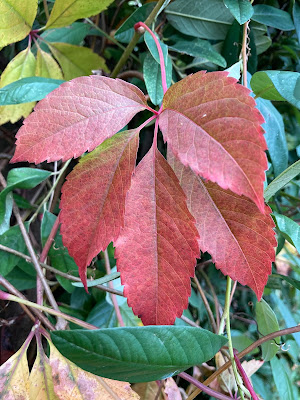
6) Virginia creeper

The virginia creeper is providing loads of colour this year and the birds are still feasting on the berries.

This weekend's jobs include dividing and potting up some houseplants, and perhaps some more cuttings. It also includes pulling out some brambles which I spotted as I was taking pics for this week's Six! Meanwhile, the cosmos flowerbuds are getting bigger and bigger and I'm hoping will burst onto the scene soon. 

That's all for this week. Check out the participant guide if you want to join in. 

16 October, 2021

Six on Saturday - 16th October 2021

Repeat flowering and seed saving

Well, it's a dreich old Saturday morning here in south east London. The rain is soft and gentle, the best sort for watering the garden but not so great for ticking off my long list of things to do out there. There's nothing for it than to get on with my thirteenth #SixOnSaturday post, six things going on in the garden this week and inspired by The Propagator. I'm doing so from a seat looking out onto the garden where the annual comedy act that is the pigeons attempting to wrestle the berries from the virginia creeper is playing out. 

Image of some flowers

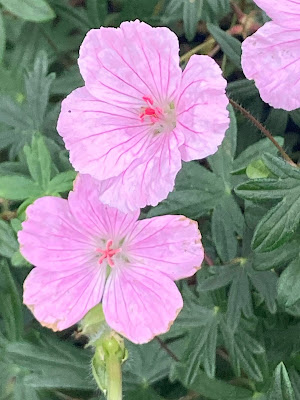
1) Geranium sanguineum var. striatum

This dainty geranium has produced another flush of pretty pink flowers. I like its slighly more compact habit, and the dark, grey-tinged leaves.   

Image of a single rose

2) Rosa "climbing iceberg"

This is possibly the third flush of flowers from this rose. It has responded well to pruning and tying in horizontally so I'll be doing more of that next year in the hope that it will finally cover the trellis behind it, giving me a scented wall of creamy white flowers in the process.

Image of a flower

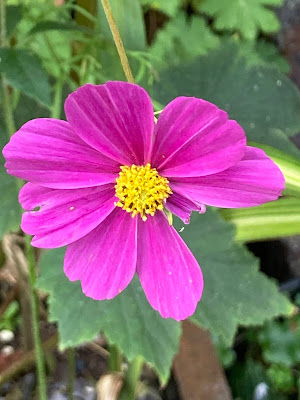
3) Cosmos

I have this cosmos courtesy of a plant swap session at one of our local gardening club meetings earlier in the year. It has taken absolutely ages to come into its own and now has a profusion of tight buds, a few of which are finally starting to open up. I'm hoping they all bloom before the frost comes. In case you are wondering, no, that isn't a cosmos leaf in the background, it is that of a Japanese anenome which is in the same pot. 

Image of some flowers

4) Geranium Rozanne ("Gerwat")

This is my first year growing Rozanne and it has delivered brilliantly on the promised "long flowering" front and is still going strong having first burst onto the scene in May. I have one plant growing alongside and through a Euphorbia characias "silver edge", just visible in the LHS of the image. The two work really well together highlighting a common bluey-grey tinge.    

5) Cucumber

I think my cucumber growing days are probably over, certainly if I don't end up getting a greenhouse. I grew two types this year and with seven plants I have had precicely five cucumbers. The one pictured here was one of two from some seeds from my next door neighbour - he'd ordered a self-polinating variety having had little success the previous year. Despite masses of flowers, only two have turned into fruit. This one was picked last weekend.  

Image of a flower and a glass jar of seeds

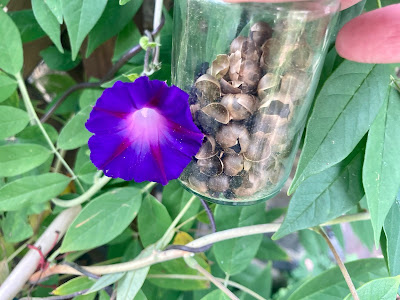
6) Morning glory - seeds for next year

I grew Morning Glory for the first time last year as a result of a seed swap amongst our local gardening club members. I was thrilled with the results and saved lots of seeds which I planted up this year. They've done wonderfully again, so I'm harvesting the seeds for next year, and for friends. This is where I think those little dessicant packages that come with lateral flow testing kits might come in useful as I'm hoping they'll capture any moisture in the seeds. As well as the saved seeds, they actually also grew well self-seeded.    

The rain is easing now and I'm hoping to get out to put some wood preserver on the the wood that has been cut for the next pallet project - another planter.

That's all for this week. Check out the participant guide if you want to join in.

09 October, 2021

Six on Saturday - 9th October 2021

Seeing Red

After a bit of a gap, and on a pretty foggy Saturday morning here in south east London, here's my twelfth #SixOnSaturday post, six things going on in the garden this week and inspired by The Propagator. There's a red theme this week

Bowl containing chilli peppers and tomatoes

1) Chilli Peppers

I grew peppers for the first time this year. I have absolutely no idea what type they are as the packet they came in was simply marked "Chilli Pepper Seeds" and was part of a Mexican-themed party box from work to spice up our otherwise online Christmas Party. There were seven seeds from which I grew six viable plants. All have produced chillies whose size and shape suggests Padrom, Apache or JalapeƱo.   

Flower

2) Salvia "Hot Lips"

Hot Lips has got her lips back having started the flowering season with pure white blooms.  She continues to flower vigorously. The plant is placed by a path and I love the scent that the leaves release when you brush by it.

Large flowerhead

3) The plant formerly known as Sedum

This year has been a good one for the sedums in my garden. The original plant has been much propogated through spring division and at this time of year give fantastic displays in shady and sunny borders alike, with the intensity of the red deepening over time. They are hugely prone to flopping and so next year I'm planning to grow some through Peony support cages. I've been surprised how good they are as cut flowers so at least the very flopped ones have had a second life in a vase. 

Bowl of ripe tomatoes

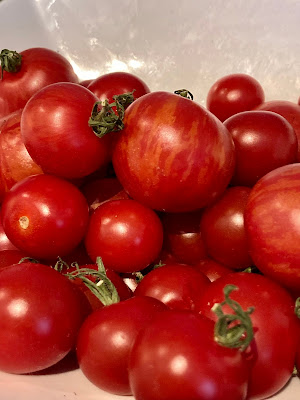
4) Tomatoes

I grew two kinds of tomato this year, Tigrella and Gardener's Delight. I had so many successful seedlings and many went to neighbours or appeared on local charity stalls. I tend to keep some in my little greenhouse and then grow the remainder outside. This year all the outside ones suffered from blight and had to be destroyed. Those in the greenhosue fared much better and all the fruit ripened nicely. Yesterday I picked the last ones and the plants have been chopped and added to the compost heap.    

Branch with small leaves and berries

5) Cotoneaster berries

This is the time of year when cotoneaster comes into its own, with the rich red fruit contrasting the small glossy green leaves of the plant. The birds love the berries. 

A plant with flowers

6) Cyclamen

With their perky flowers and distinctively marked leaves, cyclamen for me signal the onset of autumn. One plant has, this year, produced a large number of offspring which I'm now attempting to grow on.   

The fog is lifting and the forecasted sunny day looks like it will be delivered, so we are hoping to get the bikes out and gently trace the Thames Path.

That's all for this week. Check out the participant guide if you want to join in.


14 August, 2021

Six on Saturday - 14th August 2021

Introduction

One consequence of the exceptionally wet period we've had recently is that my water buts are all full, something I dont' think I've ever known in August before. That's the good news. Not so good are signs of early blight on the tomato plants that I'm growing outdoors in my veg area in a part of the garden which is becoming increasingly shady because of the surrounding trees. The rain has made that part of the garden very humid which is the most likely cause of the problem. On a cheerier note, I'll welcome you to my eleventh #SixOnSaturday post, six things going on in the garden this week and inspired by The Propagator.

Picture of a blue flower

1) Agapanthus Silver Moon

Another first for me. This was an impulse buy when I visited the Secret Garden, a garden centre in Crystal Palace. I was attracted to the foliage which is variegated. I'm glad I went with impulse rather than sense - I have another pot of agapanthus plants which have never flowered so I'm not entirely sure why I thought this might be any different. Anyhow, it has rewarded my inpulse. 

Picture of a close-up of a hairy plant stem and a flower bud

2) Butternut Squash

Picture of green plants
I'm growing Butternut Squash for the first time this year. I have two plants which I'm growing vertically. I'm intrigued by the exceptionally hairy stems and flower buds. Despite looking very healthy and reaching a height of about six feet, the flower buds are still tight. I'm hoping that with the current warmer, dryer and sunnier weather that we've had over the last week, and which is promised for next, might persuade the flowers to mature.  If not, then I'll have some good material for compost.


Picture of a bowl of water with a stone in it

3) Water

In addition to the pond, we have a few bowls which we keep filled with water for the birds and insects. This one has a stone in it which helps bees, wasps and small birds reach in to drink. It doesn't stop birds of all sizes using it as a bath - everything from robins and tits right up to pigeons and magpies spashing around, sending water flying everywhere. There is a seating area nearby and sometimes when I'm sitting reading the birds will come down to bathe which is lovely to see so close at hand.

Picture of a garden with a rainbow in the sky

4) The lawn

Picture of grass with white flowers
The part of the garden nearest the house is largely lawn framed by borders all of which gently slope upwards towards the summerhouse. We like it that way because from the house it enables us to see the sky, the birds and the wildlife and the borders blend in with the woodland behind giving a sense of borrowed landscape, a real treat for London's travel zone 2! It is not manicured grass and other than a regular mow, an occasional edge trim, and rake towards the end of the year to thin the moss, it gets no special treatment whatsoever. Over the years it has settled to a combination of grass, white and pink clover, daisies and buttercups. One corner has gradually been colonised by bluebells and primulas and throws up a lovely spring display before being mowed towards the end of May. I regularly let it go for a couple or three weeks so that the bees can have a fill of the clover. From a distance when freshly mowed it looks immaculate, that is, until a squirrel decides to excavate a long-burried peanut!


Picture of two upright flowers with house in the background

5) Canna

I know, Canna two weeks in a row. Since last week a second bloom has started to emerge from the plant that previously reflused to flower for two years. I'm holding out hope that there may be a third. 

Picture of a flower

6) Hydrangea paniculata "Bombshell"

Another reluctant flowerer which has redeemed itself this year. I planted this two years ago out the front of the house following some re-modelling of the area. It flowered the first year and did zilch last year. This year it is back. I love how the flowerheads start off a delicate lemon colour, then go creamy white before taking on a delicate pink tinge. 

That's all for this week as there is a lot on the "to do" list. Check out the participant guide if you want to join in.


Telegraph Hill Open Gardens 2026

  Telegraph Hill Open Gardens 2026 Saturday 6th and Sunday 7th June 2026, 14:00 - 18:00 We have 18 gardens lined up to open across the weeke...