Showing posts with label Lemon Tree. Show all posts

25 June, 2023

Six on Saturday - 24th June 2023

All things blue and beautiful

A whole five months since my last post and I've not even managed to get it out on a Saturday! I did actually start writing it early yesterday morning and I started with  "It's a beautiful morning". Then, all the jobs that I set myself to get done before heading out for a day of singing took over, and that's as far as I got. So, now it is Sunday afternoon. Let's see how far we get this time. 

It's a swealtering 29 degrees outside, Sunday afternoon 24th June  2023. At times like this I'm really grateful for the shaded areas of the garden and earlier I took full advantage, sitting right down at the bottom writing up my diary, and completing this week's column in my gardening five year record book, something I also started earlier in the year. In fact the record book is possibly the reason for not getting back to the blog as by the time I've written that up I've thought of a thousand things to do in the garden and then, before I know it, it is not Saturday anymore. 

It's the time of year when all the learner fledglings try out the bird feeders. A new one this year has been a young greater spotted woodpecker. For a couple of weeks now it has followed its mother around the garden,  calling after her and landing slightly ginergly, sometimes ending up suspended underneath a feeder and apparently trying to work out "what next". Today it was alone and a lot more confident.  Also out and about are a large number of damselflies. Earlier in the week there were at least four pairs, hooked up in tandem, the rear female dipping her tail in the pond, presumably laying eggs. And after some refreshing rain, rain which filled two of the four water butts, I saw at least two toads. I'd been worried they'd all disappeared, especially as it looks as though this season's eggs did not survive a March frost. 

Anyhow, to planty things going on in the garden here in south east London: 
 

One: bright blue Hydrangea Macrophylla Zorro

Hydrangea Macrophylla "Zorro"


Last year Zorro's flowering season was brought to a juddering halt with the insane 40 degree heat that we had. I pruned it earlier in the year and it is coming back very nicely indeed, and still nice and blue. It is in its own pot, planted in ericaceous soil, and watered with rainwater with added fortification. I don't think the flowers are quite as large as previously but there are a healthly number of them, all on gorgeous dark, nearly black, stems. 

Two: beginning to go blue

Hydrangea

I've been giving Mum's hydrangea the "Zorro" treatment. I've had it since she passed in 2014 and it has been pink most years. It certainly has some blue tinges now. Come back in another year or two to see if I've been successful in turning the pompoms blue. 

Three: blue bee heaven
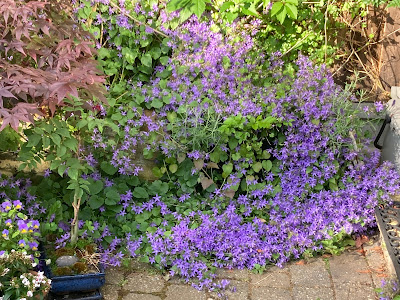
Campanula

This is one of several profusions of campanula which are dotted around the garden. The bees adore it if the buzzing is anything to go by.  

Four: bicycle blues


An ornamental wrought iron bicycle planter with pots of flowers in the front basket, side pedals, the seat and in the rear paniers. Filled with lobellia and pelargonium


Dad gave me this last year and would have loved to see it planted up like this. He and Annie had had it in their garden in Lincolnshire and it had become completely overgrown with brambles. We extracted it and realised that it could still be used as a rather quirky planter. Here it is tumbling with lobelia and geraniums. 

Five: Salvia "amethyst lips
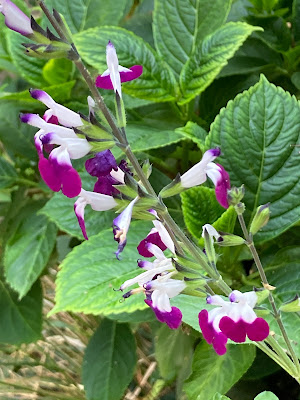
Salvia "amethyst lips"

I've discovered Salvias through our local gardening club. Seven are in flower at the moment with only Amistad and Black and Blue waiting to take off.  

Six: fortification

A fruit cage containing four pots of fruit, 2x strawberries, one lemon tree and a blueberry bush


The air was blue the other weekend when I realised that the squirrels had taken all my figs and most of the nearly ripe strawberries. I have now acquired this cage into which I've put the strawberries, the lemon tree - the blighters took all those last summer - and a blueberry bush. A determined squirrel will probably get through but I'm hoping this will be a sufficient deterrant for now and that I've secured it sufficiently so that the birds and the toads don't get tangled up in it. 

This is my latest in the #SixOnSaturdon ay series inspired by The Propagator and currently being championed over at Garden Ruminations. Check out the participant guide here. I aspire to be as disciplined, creative and inspiring as them but for now, I'll remain pleased if I can just limp on with a post every now and again.   

31 December, 2022

Six on Saturday - 31st December 2022

Last post

No, not last post ever, just for 2022. What a month it has been! In fact, what a year it has been. Apart from the frantic attempts to protect tender things just before the cold spell kicked in, the main gardening jobs this month have involved collecting leaves for leaf mold. Being surrounded by trees means that we get an awful lot of leaves! On the drier days I use the "Monty's Mow" method of collection - effectively using the lawn mower to collect and chop leaves prior to either piling into one of the compost bins, or into black bags for over-wintering. That still leaves lots which can be tucked in under the larger shrubs so that they can work their magic directly into the soil. You can read more about Monty Don's method over here

1) Pretty Freezing (2)


I'm being a bit liberal with my final six of the year. This was not taken on 31st December, but on the morning of 12th and it is the wintry scene that greeted me when I opened the curtains that morning. The temperatures remained sub-zero for a good few days and when I checked the greenhouses, as feared, there were some tender losses. On the plus side, Salvia "hot lips" appears to have survived outside.  I thought she was a gonner when the "Beast from the East" hit a few springs back.

2) Yucca gloriosa "variegata"


According to my "go to" source of information, the RHS website, Yucca gloriosa "variegata"  flowers should appear in "late summer or autumn". My plant has other ideas. Not only that, but the flower spike started appearing before the recent freeze and has showed no sign of giving up. 

3) Third time lucky? Overwintering my lemon tree. 


This is the third winter for my lemon tree. The first winter I purchased a tray, filled it with gravel, brought tray and tree inside wherupon all leaves fell off. It survived. Last winter tray and tree went into the greenhouse near the house, the plant was fed with a winter citrus food, and when it was warm enough, I took it back outside whereupon all the leaves fell off. Again. It survived. For its third winter I've popped it on a sheltered step above which, a couple of floors up, is a boiler flue. It has already survived the cold and the snow that December threw at it and is currently throwing off new shoots and flowers. The added bonus is that the squirrels have not yet located it. The critters stripped it of its 13 fruits a few months back and that was after they'd decimated the figs and the olives. I am plotting revenge.

4) Moss


The original bonsai that graced this dish died a few years back. One of the "advantages" of being surrounded by trees is that we are never short of saplings, particularly sycamore and ash. The local ash in partciular are succombing to ash dieback so each year I pot up a couple in the hope that they may be resistent. I decided to bonsai one and it has survived several  summers now. Obviously at this time of year it is leafless and dormant. Meanwhile, the birds seem to revel in pecking bits of moss from the roof and flinging them on the ground below. I've beel collecting them up and resting them on the slate chippings which are in the bonsai planter where they are surviving well in all the current damp and are providing a little ground level interest while the tree hibernates. 

5) Christmas gift


This rather speldid bug hotel was a Christmas present and has been placed in a sunny location and about 1.6m above ground. My husband tells me that I've interrupted the squirrel's route up that particular tree. Well, if that's the case then I'll have achieved two things - a home for beneficial beasties and a discombobulated squirrel or two. 

6) Hanging by a thread


new and old apron ties

My trusty garden apron is made of denim. I've had it for more years than I can remember and you'll see me sporting it towards the beginning of this little lockdown video. I'd already had to knot one of the ties once where it had frayed. Now, again hanging by a thread,  more drastic action was needed. I was delighted to find denim tape online and even more delighted that in amongst my mum's extensive collection of coloured sewing threads was one which matched the orange edging used on the tape. It should now last a few more years. 

This is my latest in the #SixOnSaturday series inspired by The Propagator and currently being championed over at Garden Ruminations. Check out the participant guide here. I aspire to be as disciplined, creative and inspiring as them but for now, I'll remain pleased if I can just limp on with a post every now and again. Meanwhile, wishing you and yours a very happy new year. 2023 needs to be a year when we all dig deep - physically and mentally - to identify further actions we can take to protect and nurture our planet. 

02 July, 2022

Six on Saturday - 2nd July 2022

Back after a break

Yes, my first #SixOnSaturday since way back in November 2021. Many flowers have been and gone since then, a new larger greenhouse has been constructed, and a bed that I'd not tackled for the 38 years I've been at this address has been dug and replanted. It did, as I predicted, give up some of the huge chunks of glazed bricks and concrete which some previous owner burried throughout our garden, wheelbarrows of them. I need to tackle more before I get too much older and creakier as each is a huge and exhausting project. This week's #SixOnSaturday, in the series inspired by The Propagator, starts with a major success.  

Blue flower of hydrangea zorro

1) Hydrangea macrophylla "Zorro"

Zorro featured on 10th July last year and was stubbornly pink alongside Mum's pompom hydrangea. I have been on a mission to see if I could get both to revert back to blue as I'd seen both blue when I first "met" them. Even though both were in pots of erricaceous compost, and only being watered with rainwater, both were pink. I resorted to a product which claimed to help restore the blue colour. It has worked beautifully with Zorro but mum's plant remains pink, possibly very slightly less pink than the last few years. My present theory is that Zorro was blue more recently than mum's, and that therefore there may yet be hope for mum's if I continue the treatment. I'll be back next year with the news. Meanwhile, Zorro is putting on an absolutely fabulous show with its blue flowers and striking black stems. My only challenge with it being in a pot is that it is now taller than me and I'd need stilts to appreciate its full spleandour. Hey ho.  

Plant with purple leaves and white flowers

2) Oxalis

I acquired my first oxalis a number of years ago. It was outdoors in the garden centre so I put it outdoors in my garden. It did that perennial thing - flowered, died at the end of the next year, returned the following year and, most importantly, didn't get eaten by slugs and snails. So I bought some more. This one sits on our exceptionally sunny kitchen window sill - completely the wrong place according to the experts - and is a gorgeous mound of dark purple shamrock leaves and pretty pink flowers. I gather it is usually grown as a housplant in the UK, so I guess that's global warming for you. 

 
Large yellow sunflower flowerhead

3) Sunflower

Here I am in my sixth decade and this is the first sunflower that I've grown from seed and which has not been eaten, decapitated or otherwise destroyed by unknown forces. I'm sure this one, too, is at risk, but it has been in the garden bringing jolly joy for a fortnight now. It is a record. The seeds for it and, yes, others, came from a gardner's club seed swap. Knowing that the parent was grown locally gave me hope which has been rewarded. 

flowers

4) Unlikely survivors

Purchased as bedding plants in 2021 and inserted into just about the most high maintenance - small hexagonal frame, needs watering regularly - space, these have nevertheless overwintered only to come back for a second year. Words fail . . .   

5) Lemon in waiting

I acquired my first lemon tree in 2020. I overwintered it indoors - bad mistake as the dry heat resulted in significant leaf loss. It survived, went outside last year and produced a few lemons. Last winter I over-wintered it in a greenhouse by the house. Leaves remained attached, as did the unripe lemons. Then, after I thought that it was safe to put it out, I put it out - bad mistake n.2 as the shock of the outside resulted in near total leaf loss. I did not give up. Right now it is covered in lovely new dark leaves and very many headily-scented flowers. I am hopefull that fruit will follow.   

View through the entrance to a greenhouse showing young plants on shelves

6) Propogation central

The challenge with the bottom half of the garden is that it is surrounded by very mature trees. Anything I plant directly into the ground immediately competes with tree roots for water and nutrients. Add raised beds and compost and what you get is a raised bed full of tree roots! I've gone from feeding expensive plants to slugs and snails to feeding local trees. Meanwhile, my tiny greenhouse by the house was overflowing with cuttings and has been a very successful location for maturing tomatoes. I decide to clear one of the raised beds down the bottom, get it level, and install a second larger model. I'd originally thought I'd treat myself to a very fancy new greenhosue but after a frustrating exchange with a potential supplier, went very low budget with a larger version of the zip-up one by the house. A "feature" of our garden is that nothing is level, Telegraph Hill is, well, a hill, and we are on the side of it. Job one - see if you can create a level surface in a sloping garden. Even though what I'd purchased was a very cheap model, I decided I'd try to protect its frame. We try to re-cycle things and to do that, we store things that "might be useseful". In amongst the stash we had the wood that had been used as shuttering when we had our front path laid, and some offcuts of stone from when we had the steps replaced. We also had some old radiator bricks, and the slats from some old wooden venetian blinds. I created a frame for the greenhouse base (to stop it rusting) which itself is laid on the radiator bricks and infilled with gravel (to keep the wood from rotting any time soon) and the greenhouse frame is attached to the wooden frame using pipe clips. Two of the stone offcuts form the centre floor and gravel fills all the gaps. And those venetian blind slats I hear you ask? I've used those to form shelves for the lowest level of the greenhouse. Oh, and the whole thing is now rammed full of cuttings and some of this year's tomatoes.

That's all for this week. This weekend is deadheading and shrub pruning. Check out the participant guide if you want to join in.

Telegraph Hill Open Gardens 2026

  Telegraph Hill Open Gardens 2026 Saturday 6th and Sunday 7th June 2026, 14:00 - 18:00 We have 18 gardens lined up to open across the weeke...