Showing posts with label Slugs. Show all posts

02 July, 2022

Six on Saturday - 2nd July 2022

Back after a break

Yes, my first #SixOnSaturday since way back in November 2021. Many flowers have been and gone since then, a new larger greenhouse has been constructed, and a bed that I'd not tackled for the 38 years I've been at this address has been dug and replanted. It did, as I predicted, give up some of the huge chunks of glazed bricks and concrete which some previous owner burried throughout our garden, wheelbarrows of them. I need to tackle more before I get too much older and creakier as each is a huge and exhausting project. This week's #SixOnSaturday, in the series inspired by The Propagator, starts with a major success.  

Blue flower of hydrangea zorro

1) Hydrangea macrophylla "Zorro"

Zorro featured on 10th July last year and was stubbornly pink alongside Mum's pompom hydrangea. I have been on a mission to see if I could get both to revert back to blue as I'd seen both blue when I first "met" them. Even though both were in pots of erricaceous compost, and only being watered with rainwater, both were pink. I resorted to a product which claimed to help restore the blue colour. It has worked beautifully with Zorro but mum's plant remains pink, possibly very slightly less pink than the last few years. My present theory is that Zorro was blue more recently than mum's, and that therefore there may yet be hope for mum's if I continue the treatment. I'll be back next year with the news. Meanwhile, Zorro is putting on an absolutely fabulous show with its blue flowers and striking black stems. My only challenge with it being in a pot is that it is now taller than me and I'd need stilts to appreciate its full spleandour. Hey ho.  

Plant with purple leaves and white flowers

2) Oxalis

I acquired my first oxalis a number of years ago. It was outdoors in the garden centre so I put it outdoors in my garden. It did that perennial thing - flowered, died at the end of the next year, returned the following year and, most importantly, didn't get eaten by slugs and snails. So I bought some more. This one sits on our exceptionally sunny kitchen window sill - completely the wrong place according to the experts - and is a gorgeous mound of dark purple shamrock leaves and pretty pink flowers. I gather it is usually grown as a housplant in the UK, so I guess that's global warming for you. 

 
Large yellow sunflower flowerhead

3) Sunflower

Here I am in my sixth decade and this is the first sunflower that I've grown from seed and which has not been eaten, decapitated or otherwise destroyed by unknown forces. I'm sure this one, too, is at risk, but it has been in the garden bringing jolly joy for a fortnight now. It is a record. The seeds for it and, yes, others, came from a gardner's club seed swap. Knowing that the parent was grown locally gave me hope which has been rewarded. 

flowers

4) Unlikely survivors

Purchased as bedding plants in 2021 and inserted into just about the most high maintenance - small hexagonal frame, needs watering regularly - space, these have nevertheless overwintered only to come back for a second year. Words fail . . .   

5) Lemon in waiting

I acquired my first lemon tree in 2020. I overwintered it indoors - bad mistake as the dry heat resulted in significant leaf loss. It survived, went outside last year and produced a few lemons. Last winter I over-wintered it in a greenhouse by the house. Leaves remained attached, as did the unripe lemons. Then, after I thought that it was safe to put it out, I put it out - bad mistake n.2 as the shock of the outside resulted in near total leaf loss. I did not give up. Right now it is covered in lovely new dark leaves and very many headily-scented flowers. I am hopefull that fruit will follow.   

View through the entrance to a greenhouse showing young plants on shelves

6) Propogation central

The challenge with the bottom half of the garden is that it is surrounded by very mature trees. Anything I plant directly into the ground immediately competes with tree roots for water and nutrients. Add raised beds and compost and what you get is a raised bed full of tree roots! I've gone from feeding expensive plants to slugs and snails to feeding local trees. Meanwhile, my tiny greenhouse by the house was overflowing with cuttings and has been a very successful location for maturing tomatoes. I decide to clear one of the raised beds down the bottom, get it level, and install a second larger model. I'd originally thought I'd treat myself to a very fancy new greenhosue but after a frustrating exchange with a potential supplier, went very low budget with a larger version of the zip-up one by the house. A "feature" of our garden is that nothing is level, Telegraph Hill is, well, a hill, and we are on the side of it. Job one - see if you can create a level surface in a sloping garden. Even though what I'd purchased was a very cheap model, I decided I'd try to protect its frame. We try to re-cycle things and to do that, we store things that "might be useseful". In amongst the stash we had the wood that had been used as shuttering when we had our front path laid, and some offcuts of stone from when we had the steps replaced. We also had some old radiator bricks, and the slats from some old wooden venetian blinds. I created a frame for the greenhouse base (to stop it rusting) which itself is laid on the radiator bricks and infilled with gravel (to keep the wood from rotting any time soon) and the greenhouse frame is attached to the wooden frame using pipe clips. Two of the stone offcuts form the centre floor and gravel fills all the gaps. And those venetian blind slats I hear you ask? I've used those to form shelves for the lowest level of the greenhouse. Oh, and the whole thing is now rammed full of cuttings and some of this year's tomatoes.

That's all for this week. This weekend is deadheading and shrub pruning. Check out the participant guide if you want to join in.

23 October, 2021

Six on Saturday - 23rd October 2021

Leaves, seeds and propagation

It's the time of year when I not only mow the lawn, but also the paths, effectively using the mower as a means of chopping up and hoovering up all the fallen leaves prior to adding them to the compost bin.

This week's #SixOnSaturday, inspired by The Propagator has a leafy theme.  

Image of a spikey seedhead

1) Teasel seedhead

I'm liking the rather striking seedheads and am looking forward to seeing them over winter, especially if we get a frost.  

Image of a large leafed plant about to come into bloom

2) Varietad Fatsia Japonica

With leaves bigger than most dinnerplates, this variegated fatsia provides year round interest. Here, it is poised to flower, providing some much needed food over winter for polinators.  
  
Image of six square plant pots each with cuttings in it

3) Propagation time

I've had mixed success with cuttings, but enough success that I still give it a go. I particularly concentrate on things that work in the garden, which aren't fodder for slugs and snails, and which are useful for filling gaps here and there, or for replacing plants that have gone leggy. This little group includes some Artemesia "Powis Castle", Erysimum (don't know variety name but it produces flowers that have orange through to purple tinges) and some Salvia. The Artemisia and Salvia both have deliciously fragrant leaves. 

Image of a single straight leaf

4) Variegated Phormium

We got our first phormium in 1993. It grew and grew and grew, it "walked" from the back of the border to the front and in the end, we had it taken out. I reckon I got about fifty viable plants from the original and since then I have used them as architectual backdrops at the backs of borders or in pots. The best specimens are perfectly fan shaped. I now keep an eye out for further offspring and remove those and pot them up for passing on. The leaves on this one are fantastically stripey and look great in a gentle breeze as they dance about. 

Image of some leaves and a flowerhead

5) Mahonia

This is another plant that provides year round leafy interest This variety is called "soft caress" and doesn't have the spiky leaves of the more common variety. As with the Fatsia, this is poised to flower. When it does it produces gorgeously scented flowers which are loved by the polinators, and then lovely black berries which are devoured by the birds.  


Image of a segmented leaf

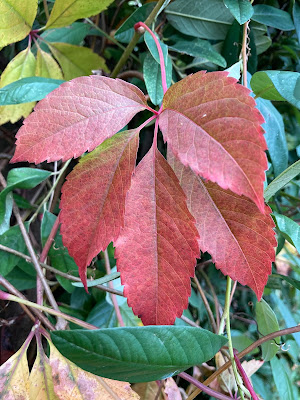
6) Virginia creeper

The virginia creeper is providing loads of colour this year and the birds are still feasting on the berries.

This weekend's jobs include dividing and potting up some houseplants, and perhaps some more cuttings. It also includes pulling out some brambles which I spotted as I was taking pics for this week's Six! Meanwhile, the cosmos flowerbuds are getting bigger and bigger and I'm hoping will burst onto the scene soon. 

That's all for this week. Check out the participant guide if you want to join in. 

07 August, 2021

Six on Saturday - 7th August 2021

 Introduction

Well, it's a pretty soggy Saturday here in SE London. Even with that, there are still new things popping up in the garden. Without further ado, then, I'll welcome you to my tenth #SixOnSaturday series, inspired by The Propagator.

Single red nasturtium flower with a backdrop of variegated leaves

1) Nasturtium

Wonderfully easy to grow from seed, reliably undemanding, and always colourful, I'll often poke a few seeds into little blank spaces. This is a tumbling one with variegated leaves and I absolutely love it. 

Single white flower with orange parts at it s centre

2) Japanese anemone honorine jobert

I love these late summer flowers which pop up as other things are starting to fade, particularly now that I've got them under control. Their original planting place was at the back of a border and before I started paying serious attention to the garden, they'd spread not only to the front of the boarder but under the path and to a neighborouing border! Some digging and dividing later, and they are now back where they should be. Meanwhile, new plants have been established and placed elsewhere in the garden for that late summer interest. 


Daisy like flowers

3) Erigeron

Another discovery via a member of our gardening club. Jolly little daisies which start off white and then fade to pink. It seems to have a really long flowering season. I have one scrambling through a pot along with some Bidens and the combination is very jolly

Toad on a brick wall surrounded by campanula flowers

4) Pest control

Say hello to one of the night pest patrol brigade. Our garden is home to a veritable army of toads - I counted at least ten of different sizes recently. Given the size and number of slugs and snails that I still find, the toads are in no danger of going hungry. We re-established the pond a few years ago and it is very pleasing to see younger generations of toad out and about.  A few years ago we had one that took to over-wintering in the outside loo. It gave me the fright of my life when I first encountered. Thereafter, we co-existed quite happily. 

Bright upright canna flower

5) Canna

This has not flowered for two years, despite careful overwintering, and masses of lush deep brown leaves. I'd threatened it with the compost heap if it did nothing this year and lo, two huge stems are emerging as are these fantastic orange flowers.  I'm not sure they will get to reach their full splendour in this rather persistent rain but I'll keep my fingers crossed. 

Flowerhead made up of lots of tiny flowers

6) Buddleja 

Another late flowerer is the Buddleja. This one one is the common "davidii". I've taken this close-up pic which shows how each of those large conical flowers is in fact made up with lots of tiny flowers each with an orange centre. No wonder the butterflies love them. 

That's all for this week. This weekend is looking like a perfect one to catch up on the ironing! Check out the participant guide if you want to join in.


14 August, 2019

The Plot

2002 incursion
The garden faces southeast. The woodland at the end, and the boundary to the south side contain many mature sycamore trees. Great for the squirrels to have fun in but not so brilliant when it comes to letting sun into the garden. It is on the side of a hill with the southwest side ground level probably around 1.5m higher than the opposite side. The soil is good old London clay with all the joys of ground movement and impossible digging conditions that that brings.

The section of the garden furthest from the house borders on to a local play area and in 2002 that border was breached and damage done to the fence and to the fledgling pond. For years therafter we did nothing to this part of the garden, concentrating our efforts on the bit nearest the house and letting the wilderness take over instead.

2014
By 2014 the two boughs of the aged apple tree had also collapsed. On the plus side, the woodpile formed a perfect environment for the stag beetles that frequent the garden on an annual basis. On the negative side, it looked a mess. It was also dangerous. The concrete paths laid by a former owner of the property had cracked and moved and were now covered in moss and ivy. During the 2002 incursion the fledgling pond that we had laboriously dug was filled with rubble and the lining was breached. However, it clearly retained enough water to enable a small  population of toads to survive. It was still damp, and there was sufficient undergrowth to hide under during the day. And my goodness, was there a fantastic food supply. In fact, how have I got this far without mentioning SLUGS.  Everywhere. Eating everything I planted. In fact it was only after years of concluding that I was a really rubbish gardner that I realised I'd actually been spending hundreds of pounds feeding lovely delicate plants to the slugs and snails.

Anyhow, I digress. Back to the "wilderness". That's where we were back in 2014, occasionally finding toads overwintering in the outside loo! 

Telegraph Hill Open Gardens 2026

  Telegraph Hill Open Gardens 2026 Saturday 6th and Sunday 7th June 2026, 14:00 - 18:00 We have 18 gardens lined up to open across the weeke...