Showing posts with label mahonia. Show all posts

07 January, 2023

Six on Saturday - 7th January 2023

New year, new beginnings

Happy New Year readers. Here are some planty things going on in my garden along with a little planning going on in my head. Six things for the latest #Six on Saturday. 

1) Bird food


I have a couple of Pyracantha bushes in the garden. One has already been completely stripped of berries by the birds, and they are now slowly going through the second bush. 

2) Bee food


Mahonia and pyracantha are two great plants to have in the garden. Pyracantha flowers in the summer, producing nectar for the bees, Mahonia flowers in the winter, producing gorgeously scented nectar for the bees who yes, are indeed still out and buzzing around at this time of year. Once the flowers are done on this mahonia, and the bees have moved on to the next flowering thing, the plant will produce long strings of black berries for the birds who, by then, will have exhausted the pyracantha berries.  Year round harvest for birds and bees. 

3) Year round interest - leaves 


This Euonymus has been in a difficult shady spot underneath a huge boundary sycamore tree for years. It provides height and interest year round and has survived the recent exceptionally cold spell. The creamy white bits of leaf pop even on the gloomiest of days. 

4) Year round interest - flowers


This  Erysimum is now getting into its own. I don't know whether it is "winter sorbet", "winter orchid", "red jep" or something completely different. I got it at one of our local gardening club gatherings. I admired it, and its owner invited me to take a cutting. It rooted nicely and is now flowering away. I love the way that the flowers are variously pink and orange. I've taken further cuttings so that there are always successors in the wings as these plants can become leggy over time. My "bowles mauve", which had flowered what felt like continuously for three or four years finally succombed during the recent cold spell, so I'm glad I had this one elsewhere in the garden. It is another one that the bees love. 

5) Promise of things to come 


It is lovely to see signs of renewal in the garden. Here we have a clutch of snowdrops poised to enter on the scene, and some nice healthy looking buds on my Hydrangea "Zorro". It flowered blue last year as I reported back in July and I'm pleased that it seems to have survived the cold.

6) Planning for things to come


It is that time of year when garden planning takes place. At various points last year I'd found myself vowing not to try veg again as I'd had so many failures. Well, there must be something in the water because I've started the year with a renewed keenness to grow some this year. I keep seeds together in a tin along with an incredibly handy sowing guide available through the RHS website. The guide is linked from this page and for each veg type, shows when to sow under cover, outdoors, when to transplant, and when you can expect your harvest. It makes "at a glance" planning nice and easy. Separately, and inspired by a piece in the latest issue of The Garden, I've acquired this five year record book. I could have paid about £15 for the latest version but managed to pick up this edition for 62p. I will now start using it to record what is in flower, what the weather is doing, and anything else garden related that is of interest, for each month of the hear for the next five years. That's the plan . . . 

This is my latest in the #SixOnSaturday series inspired by The Propagator and currently being championed over at Garden Ruminations. Check out the participant guide here. I aspire to be as disciplined, creative and inspiring as them but for now, I'll remain pleased if I can just limp on with a post every now and again.  

23 October, 2021

Six on Saturday - 23rd October 2021

Leaves, seeds and propagation

It's the time of year when I not only mow the lawn, but also the paths, effectively using the mower as a means of chopping up and hoovering up all the fallen leaves prior to adding them to the compost bin.

This week's #SixOnSaturday, inspired by The Propagator has a leafy theme.  

Image of a spikey seedhead

1) Teasel seedhead

I'm liking the rather striking seedheads and am looking forward to seeing them over winter, especially if we get a frost.  

Image of a large leafed plant about to come into bloom

2) Varietad Fatsia Japonica

With leaves bigger than most dinnerplates, this variegated fatsia provides year round interest. Here, it is poised to flower, providing some much needed food over winter for polinators.  
  
Image of six square plant pots each with cuttings in it

3) Propagation time

I've had mixed success with cuttings, but enough success that I still give it a go. I particularly concentrate on things that work in the garden, which aren't fodder for slugs and snails, and which are useful for filling gaps here and there, or for replacing plants that have gone leggy. This little group includes some Artemesia "Powis Castle", Erysimum (don't know variety name but it produces flowers that have orange through to purple tinges) and some Salvia. The Artemisia and Salvia both have deliciously fragrant leaves. 

Image of a single straight leaf

4) Variegated Phormium

We got our first phormium in 1993. It grew and grew and grew, it "walked" from the back of the border to the front and in the end, we had it taken out. I reckon I got about fifty viable plants from the original and since then I have used them as architectual backdrops at the backs of borders or in pots. The best specimens are perfectly fan shaped. I now keep an eye out for further offspring and remove those and pot them up for passing on. The leaves on this one are fantastically stripey and look great in a gentle breeze as they dance about. 

Image of some leaves and a flowerhead

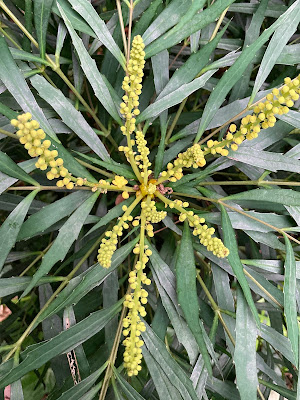
5) Mahonia

This is another plant that provides year round leafy interest This variety is called "soft caress" and doesn't have the spiky leaves of the more common variety. As with the Fatsia, this is poised to flower. When it does it produces gorgeously scented flowers which are loved by the polinators, and then lovely black berries which are devoured by the birds.  


Image of a segmented leaf

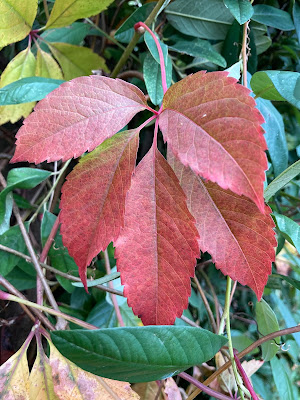
6) Virginia creeper

The virginia creeper is providing loads of colour this year and the birds are still feasting on the berries.

This weekend's jobs include dividing and potting up some houseplants, and perhaps some more cuttings. It also includes pulling out some brambles which I spotted as I was taking pics for this week's Six! Meanwhile, the cosmos flowerbuds are getting bigger and bigger and I'm hoping will burst onto the scene soon. 

That's all for this week. Check out the participant guide if you want to join in. 

Telegraph Hill Open Gardens 2026

  Telegraph Hill Open Gardens 2026 Saturday 6th and Sunday 7th June 2026, 14:00 - 18:00 We have 18 gardens lined up to open across the weeke...